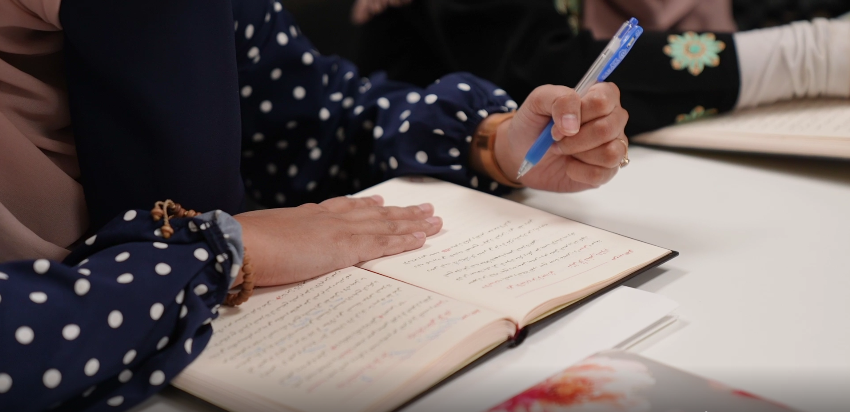
In 2020, Aala Al-Akhfash, a first year student in the Intermediate Program, graduated from a highschool in Knoxville, Tennessee as the pandemic was at its peak. Classes came to a standstill, but she was fortunate enough to be able to graduate. She recalls “it was a weird stopping point”, but little did she realize her quest for more knowledge was about to begin. Aala would walk through a gate that she never knew existed and join the cadre of Darul Qasim students that have committed themselves to an intellectually robust understanding of Islam in one of North America’s most illustrious Islamic educational institutions. In a clear and determined voice she relays:
“Whenever I decided to go to Darul Qasim everything fell into place. My intentions were genuine in the sense that all I wanted to do was learn.”
The story of her quest is one that offers a window into the life and experiences of a young, Yemeni-American woman who was determined to begin this journey with a strength of self and passion that motivated her to be better and do better. Her words and reflections highlight the reality that the gate of knowledge, while accessible to all, requires action and movement on behalf of the seeker. When speaking about her experience, her speech is sprinkled with “al-Ḥamdu lillāh’s” and pauses of gratitude saying she was gifted clarity and guidance. The support of her parents, siblings, and community members is what kept her moving with great humility and patience. In these two short years she has been at Darul Qasim, she says:
“What you get from Darul Qasim is…you are learning the Sunnah of the Prophet ﷺ, the Qur’an and the Islamic Sciences. These are things we need to know in order to function properly as Muslims. The sunnah is there for us to learn from and teaches us how to function and live in society. We won’t be able to access the Prophet’s ﷺ knowledge and teachings without this sort of learning and on our own.”
Aala, in her own words, highlights Darul Qasim’s approach to creating an Islamic intellectual curriculum and pedagogy that centers tradition in a way that equips students to navigate the challenges and issues that arise in contemporary society.
Knowledge of Self
 The daughter of Yemeni immigrants, Aala grew up in a small community in Knoxville, Tennessee. “Everyone knew everyone,” she exclaims. She is one of four children raised in a Muslim household where the Qur’an was committed to memory. Her father, a ḥāfiẓ, and her brother who is studying to be ḥāfiẓ, have always been a motivation and inspiration. Since Aala was a child, her mother has played a key role in rooting in her an understanding of the importance of knowledge. Yet, it wasn’t until the Ramadan of 2020, that she came to a realization that quite literally stopped her in her tracks. Her plan was to go to college in Tennessee.
“I really wanted to become a teacher…[I] have always loved the environment of teaching. I don’t know if it’s because I had great teachers around me like my mom. I saw how her students connected with her and loved her so much. I saw the power of a good teacher in my mother. She made her students want to be the best version of themselves.”
For Aala, Ramadan was a time of deep self-reflection and questioning. She found herself wondering about her chosen path and her identity as a Muslim woman. “I didn’t know how to be a Muslim and be comfortable in my own skin, with my hijab and everything.” The environment she had grown up in had taken a toll on her without her realizing it. Islamaphobic slurs and diatribes are unfortunately too common for many Muslim youth attending public highschools. The lack of diversity made it even more difficult to navigate the challenges of being a Muslim minority in a rural landscape.
“I spent that Ramadan reconnecting with myself and Allah ﷻ. I made a lot of duaa. One epiphany I had, as I read more and more Qur’an and observed my dad’s and brother’s connection to the Qur’an, was that I’m reading it, but I don’t understand it. I don’t understand what Allah ﷻ is trying to convey to us as Muslims. How am I supposed to follow if I don’t understand? How can I understand the word of Allah ﷻ? Or how am I supposed to do that?”
With each question, she began to make more and more duaa. “I asked Allah ﷻ to give me understanding of the Qur’an and the ability to better understand myself.” Aala kept moving and searching. She studied via online classes Arabic and tafsir to keep herself motivated. “The more classes I took the more I felt like there was something missing…I knew there was so much more to learn and a better way to learn.”
Walking Through the Gate of Knowledge
Ḥāfiẓ Noman Zaheer, her Ḥifẓ teacher, introduced her to Darul Qasim’s curriculum and the Shaykh al-Hind program in particular. “I was really enticed, it couldn’t compare to the other institutions I was researching. I said to myself I can’t do that, I’ve never studied the Islamic sciences before in a traditional setting. But imagine if I did!” With her parent’s blessings and support, Aala Al-Akhfash left home for the first time to begin her studies at Darul Qasim.
“Darul Qasim has credible scholars that guide you to the point that you will be able to explore traditional texts on your own, but under their guidance. The curriculum they laid out for us… I genuinely feel…that there is no other curriculum like this in the country. Darul Qasim stood out to me because of its curriculum and program.”
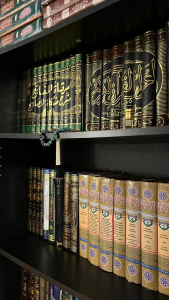
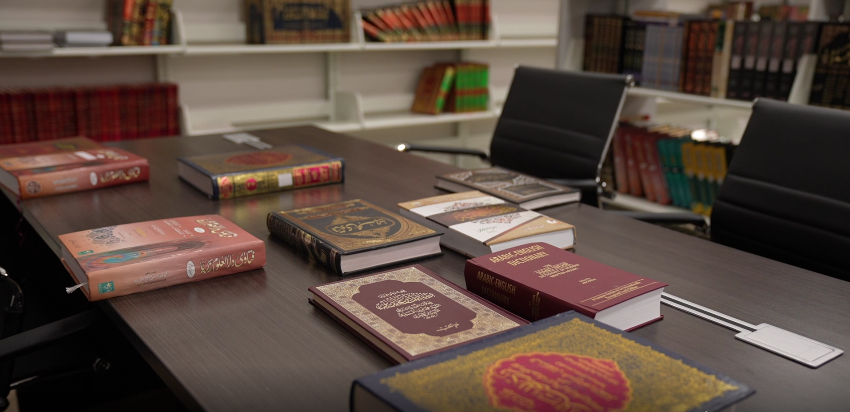
At the moment, Aala is studying one chapter of one volume of Ibn Kathir’s 22 volume work Al-Bidayah wa ‘l-Nihayah for an Aqeedah project assigned in one of her classes. She explains, such projects require rigorous research and countless hours in Darul Qasim’s library. For such projects and anything for that matter “students are able to talk to teachers comfortably…if we don’t understand we don’t feel afraid to tell the teacher. The teachers here go above and beyond.”
Currently, Aala is also taking Ustadh Firas Alkhateeb’s logic class. “Learning how to break down arguments and disprove arguments is something we are discussing right now. We have been talking about postmodernism and issues surrounding it, while also learning how to debunk those arguments.”
At Darul Qasim, classes like logic and philosophy are taught alongside hadith and tafsir. Aala notes, “Darul Qasim even more so focuses on contemporary issues and gives us the skills needed to deal with modern day issues.” She gives the example of Mawlana Arif’s tafsir class where discussions around topics like stoning that are used to attack Islam are explored through a traditional lens. In class, “we have discussions on how to respond to accusations that Islam is a barbaic religion.” These were discussions that made her uncomfortable and unsure prior to coming to Darul Qasim.
Getting to Know Aala
Aala describes herself as an outgoing person, who loves meeting new people. “I love connecting with people and hearing people’s life stories. With her friends and family she loves to joke around, but she has become a bit of an introvert. “I appreciate my own time since I’ve moved to Chicago. I appreciate having time to self-reflect. I am working on finding a balance.”
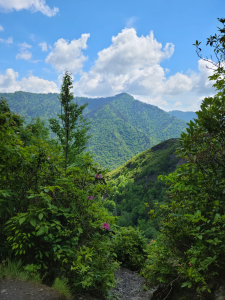
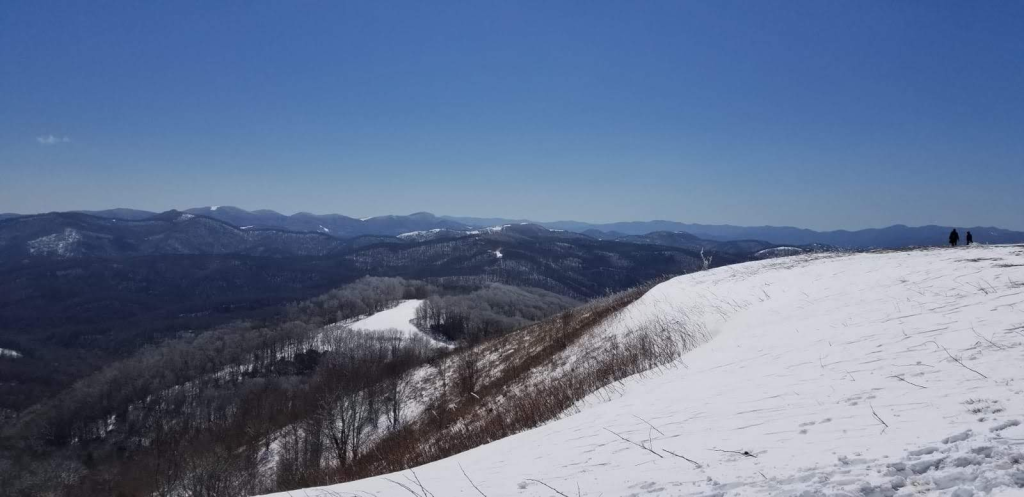
In her free time, she likes to hike, go on nature walks, sight-seeing, and road tripping. One of her most memorable hikes was climbing to the top of the Max Patch Mountains located on the border of North Carolina and Tennessee. “It was winter and it was snowing a lot. The clouds were under us. We got to the top and it was the best feeling ever!”
Staying true to her Yemeni roots, she reveals, she’s an avid coffee drinker. She loves a good iced latte. “I’m Yemeni, coffee is in my blood!”

She shares, she used to read a lot more and more recently she has rekindled her love for reading. “I enjoy reading fiction, supernatural stuff. Recently, I read The Fifth Wave.” Her current favorites are Imam Ghazali’s Iḥyāʾ ʿulūm al-dīn series, an abridged version, and The Divine Reality by Hamza Andreas Tzortzis.
“I always return to the Iḥyāʾ because it helps me to reconnect with myself. It helps me as a student, redirects my intentions. And it helps me with my love for Allah ﷻ and the Prophet. The Divine Reality gives proofs for Islam in logical arguments. I’m enjoying reading it alongside studying logic with Ustadh Firas.”
The transformations Aala Alakhfash has undergone as a student walking through the gate of knowledge is why the story of Darul Qasim is important. She shares her story because she was able to embark on a journey she deemed impossible at first. “These fruits I have been able to reap and benefit from since being here are the very reason I see Darul Qasim as an invaluable gift I would not want to give up for anything. […] There were many Islamic institutions to choose from, but I was certain that this was the right place for me. I knew I wouldn’t be able to find the authenticity and credibility that Darul Qasim provides anywhere else, especially in the United States.”